

Spain votes on Sunday 29 November. The election was called early, after the government lost a vote in Congress on emergency housing measures, and housing has since moved to the centre of the campaign. For anyone buying, selling or owning property in Marbella, it is worth knowing who the main parties are and what they have said they would do.
Below, we set out the four main parties, where each sits politically, and what their manifestos say about housing. A manifesto is a list of what a party wants to do, not what it will do, and with no party expected to win outright, much will be settled in coalition talks. We have kept to what is on the record.
The four parties at a glance
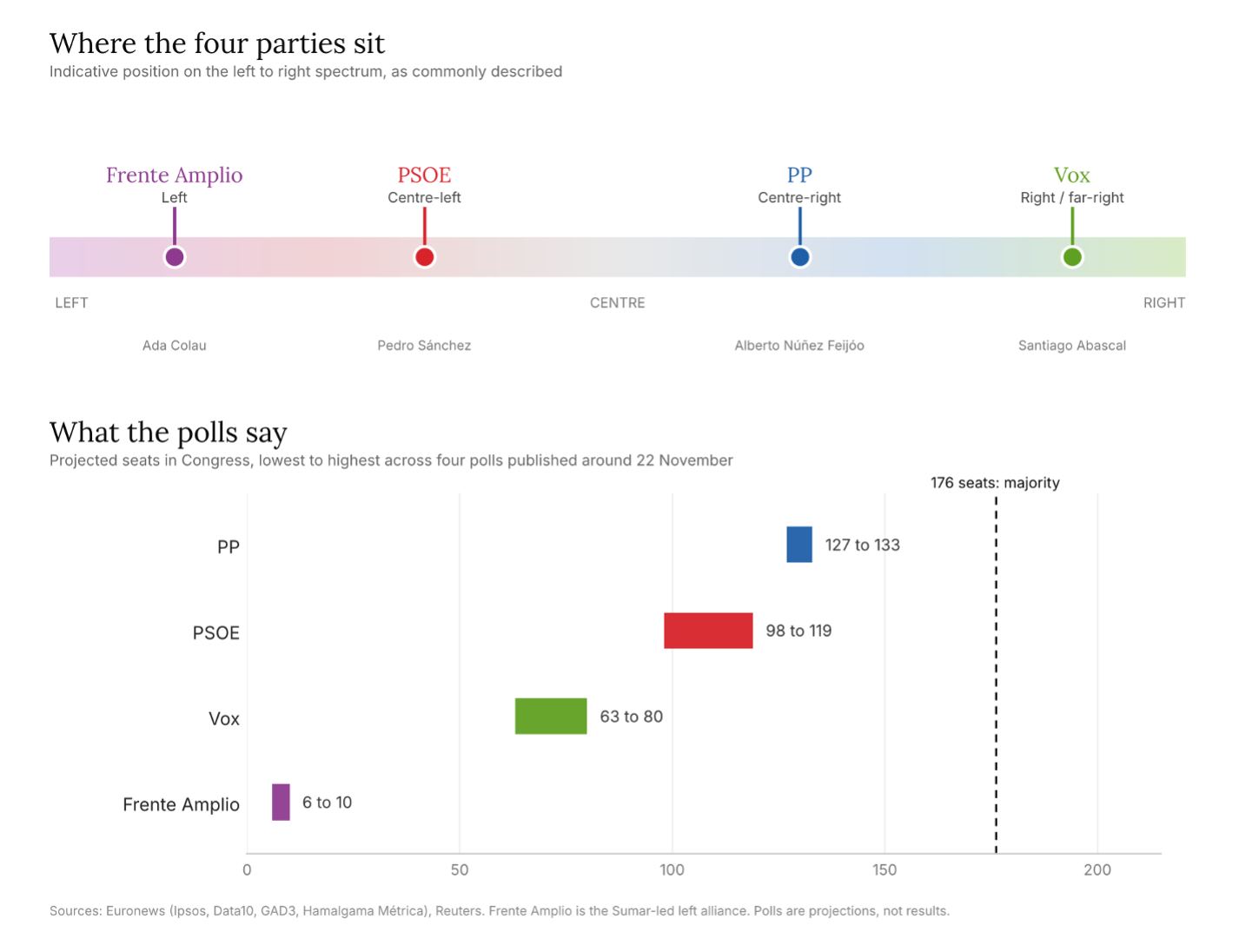
The most recent polls, published a week before the vote, point the same way. The PP is first, the PSOE second and Vox third. Between 190 and 210 seats are projected for the PP and Vox combined, against 176 needed for a majority in the 350-seat Congress. Polls differ from one another and are not results, but they explain why coalition arithmetic is the main story.
Partido Popular (PP) Centre-right
Led by Alberto Núñez Feijóo, the former president of Galicia. The party describes itself as pro-business, pro-European and pro-Atlantic, with lower taxes and growth through productivity at the core of its message. It came first in the 2023 election but could not form a government, and it leads the latest polls.
Spanish Socialist Workers’ Party (PSOE) Centre-left
Led by Prime Minister Pedro Sánchez, who is seeking a third term and has governed in a minority coalition with Sumar. The party is social democratic, with an emphasis on public spending, wages and the welfare state. The polls place it second, a few points behind the PP.
Vox Right to far-right
Led by Santiago Abascal. Vox combines nationalism, tougher positions on immigration and economic deregulation. It is commonly described as far right, a label the party rejects. It won 33 seats in 2023 and is polling at around 18 per cent, almost six points above where it was then.
Frente Amplio (the Sumar-led left alliance) Left
A new coalition built around Sumar, registered in October with fifteen parties and groups including Izquierda Unida, Más Madrid and the Comuns. It is led by Ada Colau, the former mayor of Barcelona, as Yolanda Díaz is not standing again. Its platform is left-wing and green, centred on public services, taxing large fortunes and shorter working hours. Sumar won 31 seats in 2023, but the polls now project far fewer. Podemos, further to the left, is standing separately in most regions.
What each party says about housing
PP: build more, regulate less
The PP’s programme, La Reconstrucción Nacional, runs to 82 pages and 249 measures. It promises one million homes, a new land law, building licences decided within three months (with silence counting as approval) and a shorter planning process. For buyers, it proposes cutting VAT on a first new home from 10% to 4% for under-40s, a public guarantee covering up to 20% of the price, and a savings scheme with a 20% tax deduction. It would repeal the current Housing Law, including the rent price index and the “stressed market” zones, give tenants a tax deduction, and reward landlords who renew leases for three more years with increases below inflation. It also promises that squatters can be removed within 48 hours with a court order.
PSOE: more public supply, more rental rules
The PSOE’s programme, La fuerza de seguir avanzando, has 114 pages and 500 commitments, around 50 of them on housing. It would amend Article 47 of the Constitution to make housing an enforceable right and mobilise 1% of GDP a year. A state company, Casa 47, would manage a public stock of 100,000 homes, alongside a state land bank and the rehabilitation of 550,000 homes. On rents, it would lengthen contracts and temporarily freeze rents above reference prices in high-demand areas. It would keep TuCasa, the interest-free loans of up to €50,000 for a first home, and introduce a progressive tax on empty, tourist or abusively priced homes held by funds and large owners. It would keep the limit on purchases by speculative funds, and allow councils to tax tourist overnight stays.
Vox: deregulation and “national priority”
Vox would repeal the Housing Law and rent intervention, free up more land, allow greater building density and cut the taxes and costs of buying a home. As reported, it would remove VAT on a Spanish family’s first home, remove transfer tax on a used home for a Spanish family and restore the main-residence tax deduction, with tax incentives for long-term lettings. It would give priority in social housing and rent aid to Spaniards, based on length of residence, and apply different tax treatment to buyers from outside the EU and to speculative funds, without yet giving a rate. It would also speed up the removal of squatters and ban renting to people in Spain illegally.
Frente Amplio: the most interventionist plan
Frente Amplio would invest 1% of GDP a year in public housing, and has been reported to aim for 1.5 million public homes over twelve years. It would cap rents in stressed zones, make contracts indefinite with automatic renewal, and ban companies and investment funds from buying homes. It would remove tourist-flat licences in stressed zones within three years and charge 21% VAT on tourist lets. As reported, it would also introduce a 10% tax on the value of homes owned beyond certain thresholds, from the first home for companies and the fourth for individuals, where the total value exceeds €800,000. Podemos goes further, with a proposed 40% cut in rents.
Where the parties agree and where they split
Everyone promises more homes. The real division is over how the rental market is run, and who is allowed to buy.
| PP | PSOE | Vox | Frente Amplio | |
| Rent rules | Repeal Housing Law, scrap price index in stressed zones | Longer contracts, temporary freeze above reference prices | Repeal; tax incentives for long-term lets | Rent caps in stressed zones, indefinite contracts |
| Building more | One million homes, new land law | 100,000 public homes via Casa 47, state land bank | Free up land, higher density | 1.5 million public homes over twelve years (reported) |
| Help to buy | 4% VAT on first new homes for under-40s, state guarantee | TuCasa interest-free loans up to €50,000 | No VAT on a Spanish family’s first new home, no transfer tax on a used one | Focus on public and affordable rental |
| Funds and large owners | Not a focus | Progressive tax on empty, tourist or abusively priced homes | Different tax treatment for speculative funds | Ban on companies and funds buying homes |
| Tourist lets | Not covered | Councils may tax overnight stays | Not a focus in the summaries reviewed | Remove licences in stressed zones, 21% VAT |
| Buyers from abroad | Not covered | Not in programme summaries (a 100% tax on non-EU non-resident buyers was proposed in 2025) | Different tax treatment for non-EU buyers | Not covered (the ban targets companies and funds) |
Where this touches Marbella
Many of the headline promises are aimed at first-time buyers and tenants in Spain’s large cities, and the typical Marbella purchase sits outside them. A few proposals would still reach buyers and owners here, and they are worth watching.
- Buyers from outside the EU. Vox proposes different tax treatment for non-EU buyers, and the PSOE floated a 100% tax on purchases by non-EU non-residents in 2025. This would matter for buyers from the UK, the US and elsewhere outside the EU. Irish and other EU buyers are not the target of either proposal.
- Letting. The new 10% VAT on short stays is already in the decree validated on 12 November. The parties differ on tourist lets, from councils taxing overnight stays to removing licences in stressed zones.
- Funds and companies. The PSOE would tax large owners’ empty or tourist homes, and Frente Amplio would ban companies and funds from buying. Anyone investing through a company, or holding several properties, should follow this closely.
- Rent regulation. The PP and Vox would repeal the Housing Law, while the PSOE and Frente Amplio would extend and tighten it. Long-term landlords would see the biggest difference.
Our advice is steady. Spanish housing policy has been changing for some time and will keep changing under any government, and manifesto promises become law only through parliament, often after negotiation. The decisions that stand up are those based on how you intend to use the property, with a Spanish lawyer and tax adviser alongside you. We would be glad to introduce specialists from our network.
Five questions we are being asked
1. When is the election, and how many seats are needed for a majority?
Spain votes on Sunday 29 November. The Congress has 350 seats, so 176 are needed for a majority.
2. Which parties are expected to do best?
The most recent polls put the PP first, the PSOE second and Vox third, and suggest that only the PP with Vox could reach 176 seats. Polls are projections, and coalition talks usually follow a Spanish general election.
3. Do any of the parties propose changes for international buyers?
Vox proposes different tax treatment for buyers from outside the EU, and the PSOE floated a 100% tax on purchases by non-EU non-residents in 2025. The PP and Frente Amplio proposals, as we have seen them, do not target international buyers. None of these is law.
4. What happens to the housing decree that was validated on 12 November?
It stands for now. The PP has said it would repeal the decrees if it governs, and any new government could amend or repeal them, but this would take time and depends on parliament. As it currently stands, we do not believe that the housing decree would be reversed by a PP government.